
Social media marketing is the use of social media platforms and websites to promote a product or service.[1] Although the terms e-marketing and digital marketing are still dominant in academia, social media marketing is becoming more popular for practitioners and researchers.[2]
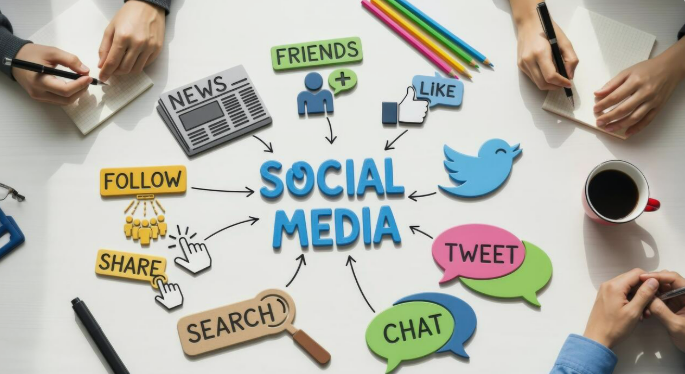
Social media platforms such as Facebook, LinkedIn, Instagram, and X, among others, have built-in data analytics tools that companies can use to track the progress, success, and engagement of social media marketing campaigns. Companies address a range of stakeholders through social media marketing, including current and potential customers, current and potential employees, journalists, bloggers, and the general public.
On a strategic level, social media marketing includes the management of a marketing campaign, governance, setting the scope (e.g. more active or passive use) and the establishment of a firm’s desired social media “culture” and “tone”.
Firms that use social media marketing can allow customers and Internet users to post user-generated content (e.g., online comments, product reviews, etc.), also known as “earned media“, rather than use marketer-prepared advertising copy.
Purposes and tactics
social media may be employed in marketing as a communications tool that makes companies accessible to those who are interested in their product and visible to those who are not familiar with their products.[3] It is used by companies to create buzz, learn from customers, and target them.[4]
Of the top 10 factors that correlate with a strong Google organic search, seven are social media-dependent. This means that if brands with little to no social media presence tend to show up less on Google searches.[5] While platforms such as Twitter, Facebook and—in the past—Google+ have a larger number of monthly users, the visual media-sharing-based mobile platforms garner a higher interaction rate in comparison, and in 2013 registered the fastest growth, changing the ways in which consumers engage with brand content. In 2013, Instagram had an interaction rate of 1.46% with an average of 130 million users monthly as opposed to Twitter, which had a .03% interaction rate with an average of 210 million monthly users.[5] Unlike traditional media that are often cost-prohibitive to many companies, a social media strategy does not require significant financial investment.[6]
To this end, companies make use of platforms such as Facebook, X (formerly Twitter), Pinterest, Instagram to reach audiences much wider than through traditional print, television, or radio advertisements alone at a fraction of the cost, as most social networking sites can be used at little or no cost (however, some websites charge companies for premium services). This has changed the ways that companies approach and interact with customers, as a substantial percentage of consumer interactions are now being carried out over online platforms with much higher visibility. Customers can post reviews of products and services, rate customer service, and ask questions or voice concerns directly to companies through social media platforms.
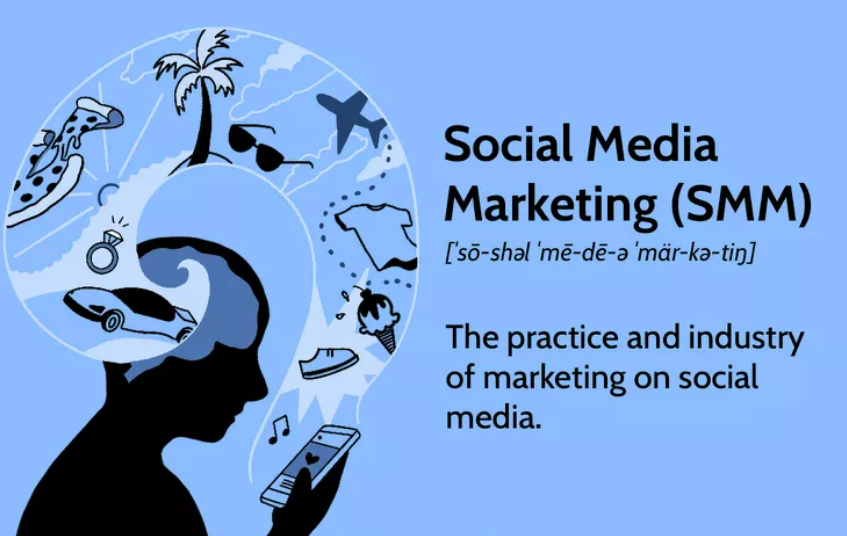
“Connect. Engage. Grow. That’s the power of social media marketing. 📈”
According to Measuring Success, over 80% of consumers use the web to research products and services.[7] Thus social media marketing is also used by businesses in order to build relationships of trust with consumers.[citation needed] To this aim, companies may hire personnel to specifically handle these social media interactions, who usually report under the title of online community managers. Handling these interactions in a satisfactory manner can result in an increase of consumer trust. To both this aim and to fix the public’s perception of a company, three steps are taken in order to address consumer concerns:[citation needed]
- Identifying the extent of the social chatter
- Engaging the influencers to help
- Developing a proportional response
Passive approach
Social media can be a useful source of market information and a way to hear customers’ perspectives. Blogs, content communities, and forums are platforms where individuals share their reviews and recommendations of brands, products, and services. Businesses are able to tap into and analyze customer voices and feedback generated in social media for marketing purposes.[8] In this sense, social media is a relatively inexpensive source of market intelligence which can be used by marketers and managers to track and respond to consumer-identified problems and detect market opportunities.
Active approach
Social media can be used as a public relations tool, a direct marketing tool, and a communication channel to target very specific audiences, with social media influencers and social media personalities as effective customer engagement tools.[8] This tactic is widely known as influencer marketing, which gives brands the opportunity to reach their target audience via a group of selected influencers advertising their product or service. Brands were projected to spend up to $15 billion on influencer marketing by 2022, per Business Insider Intelligence estimates, based on Mediakix data.[9] The use of customer influencers, such as popular bloggers, can be an efficient and cost-effective method to launch new products or services.[10]
Trend simulation
Trend simulation is a digital marketing approach to manufacturing interest, typically through social media marketing through the deployment of burner pages, fake accounts, and volume posting.[11][12] The technique ‘s artificial seeding to steer discourse and induce viral marketing has been criticized as an unethical psyop.[13] [14][15][16]
Engagement
Engagement with the social web means that customers and stakeholders are active participants rather than passive spectators. An example of these are consumer advocacy groups and groups that criticize companies (e.g., lobby groups or advocacy organizations). The use of social media in a business or political context allows people to express and share opinions about a company’s products, services or business practices, or a government’s actions.
On social media, each participant becomes part of the marketing department (or a challenge to the marketing effort) as other customers read their comments or reviews. The effectiveness of social media marketing campaigns is dependent on the promotion of online engagement.[17] With the advent of social media marketing, it has become increasingly important to gain customer interest in products and services, which can eventually be translated into buying behavior, or voting and donating behavior in a political context. New online marketing concepts of engagement and loyalty have emerged which aim to build customer participation and brand reputation.[18]