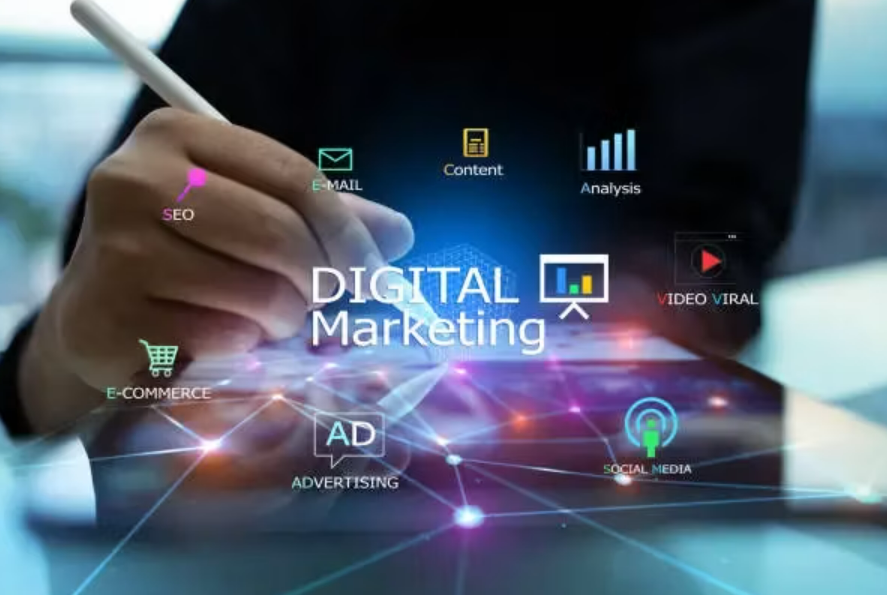
Digital marketing is a component of marketing that uses digital technologies such as desktop computers, mobile phones, and other digital media platforms to promote products and services.[2][3]
It has significantly transformed how brands and businesses use technology for marketing since the 1990s and 2000s. As digital platforms became increasingly incorporated into marketing plans and everyday life,[4] and as people increasingly used digital devices instead of visiting physical shops,[5][6] digital marketing campaigns have become increasingly prevalent, employing combinations of methods. These methods include search engine optimization (SEO), search engine marketing (SEM), content marketing, influencer marketing, content automation, campaign marketing, data-driven marketing, e-commerce marketing, social media marketing, social media optimization, e-mail direct marketing, display advertising, e-books, optical disks and games. Digital marketing also extends to non-Internet channels that provide digital media, such as television, mobile phones (SMS and MMS), callbacks, and on-hold mobile ringtones.[7]
The extension to non-Internet channels differentiates digital marketing from online marketing.[8]
History
Digital marketing effectively began in 1990 when the Archie search engine was created as an index for FTP sites. During the 1980s, the storage capacity of computers was already large enough to store large volumes of customer information. As a result, companies started choosing online techniques such as database marketing rather than relying on limited list brokers.[9] These databases allowed companies to track customers’ information more effectively, transforming the relationship between buyers and sellers.
In the 1990s, the term digital marketing was coined.[citation needed] The first clickable banner ad, the “You Will” campaign by AT&T, launched in 1994. Within the first four months, 44% of all people who viewed the advertisement clicked on it.[10][11] Early digital marketing efforts focused primarily on simple HTML websites and the burgeoning practice of email marketing, which enabled direct communication with consumers.[12]
In the 2000s, with increasing numbers of Internet users and the introduction of the iPhone, customers began searching for products and making decisions online instead of consulting a salesperson, which created a new problem for the marketing department of a company.[13] Additionally, a survey conducted in the United Kingdom in 2000 revealed that most retailers had not yet registered their own domain names.[14] These challenges encouraged marketers to explore new ways to integrate digital technology into marketing strategies. At the same time, pay-per-click (PPC) advertising, introduced by Google AdWords in 2000, allowed businesses to target specific keywords, making digital marketing more measurable and cost-effective.[15]
The mid-2000s saw the emergence of social media platforms such as Facebook (2004), YouTube (2005), and Twitter (2006). These platforms revolutionized digital marketing by facilitating direct and interactive engagement with consumers. In 2007, marketing automation was introduced as a response to the rapidly evolving marketing climate. Marketing automation is the process by which software is used to automate conventional marketing processes.[16] Marketing automation helps companies to segment customers, launch multichannel marketing campaigns, and provide personalized information for customers,[16] based on their specific activities. In this way, users’ activity (or lack thereof) triggers a personal message that is customized to the user in their preferred platform. However, despite the benefits of marketing automation many companies are struggling to adapt it to their everyday uses correctly.[17][page needed]
Digital marketing became increasingly sophisticated during the 2000s and 2010s, when[18][19] the proliferation of devices capable of accessing digital media led to sudden growth.[20] Statistics produced in 2012 and 2013 showed that digital marketing continued to grow significantly.[21][22] With the development of social media in the 2000s, such as LinkedIn, Facebook, YouTube, and Twitter, consumers became highly dependent on digital electronics in their daily lives. Therefore, they expected a seamless user experience across different channels for searching product information. The change in customer behavior improved the diversification of marketing technology.[23]
Digital media growth was estimated at 4.5 trillion online ads served annually with digital media spending at 48% growth in 2010.[24] An increasing portion of advertising stems from businesses employing Online Behavioural Advertising (OBA) to tailor advertising for internet users, but OBA raises concerns about consumer privacy and data protection.[20]
In the 2020s, AI-generated responses began to be offered as a replacement for simple search engine results.[25][26] Digital marketers developed methods known as generative engine optimization (GEO) or answer engine optimization (AEO) to market via these tools.[27][28][26]

“Grow your business, reach the right audience, and turn clicks into customers with smart digital marketing. 🚀📈”
Brand awareness
Main article: Brand awareness
One of the key objectives of modern digital marketing is to raise brand awareness, the extent to which customers and the public are familiar with and recognize a particular brand.
Enhancing brand awareness is important in digital marketing, and marketing in general, because of its impact on brand perception and consumer decision-making.[29]
Channels
Digital marketing channels are systems based on the Internet that create, accelerate, and transmit product value from producers to consumers through digital networks.[30][31] Digital marketing is facilitated by multiple channels, as an advertiser’s core objective is to find channels which result in maximum two-way communication and a better overall ROI for the brand. There are many digital marketing channels available.[32]
Digital marketing allows consumers to give back feedback to the firm on a community-based site or straight directly to the firm via email.[33] Firms seeking this long-term
communication relationship use multiple promotional strategies related to their target consumer as well as word-of-mouth marketing.[33]
Affiliate marketing
Affiliate marketing is perceived to not be considered a safe, reliable, and easy means of marketing through online platforms due to a lack of reliability in terms of affiliates that can produce the demanded number of new customers. As a result of this risk and bad affiliates, brands are left prone to exploitation in terms of claiming commission that is not honestly acquired. Legal means may offer some protection against this, yet there are limitations in recovering any losses or investment. Despite this, affiliate marketing allows brands to market towards smaller publishers and websites with smaller traffic.[34]