

E-commerce (electronic commerce) refers to commercial activities including the electronic buying or selling products and services which are conducted on online platforms or over the Internet.[1] E-commerce draws on technologies such as mobile commerce, electronic funds transfer, supply chain management, Internet marketing, online transaction processing, electronic data interchange (EDI), inventory management systems, and automated data collection systems. E-commerce is a part of retail. It is the largest segment of the electronics industry and is in turn driven by the technological advances of the semiconductor industry.
Defining e-commerce
The term was coined and first employed by Robert Jacobson, Principal Consultant to the California State Assembly’s Utilities & Commerce Committee, in the title and text of California’s Electronic Commerce Act, carried by the late Committee Chairwoman Gwen Moore (D-L.A.) and enacted in 1984.
E-commerce typically uses the web for at least a part of a transaction’s life cycle although it may also use other technologies such as e-mail. Typical e-commerce transactions include the purchase of products (such as books from Amazon) or services (such as music downloads in the form of digital distribution such as the iTunes Store).[2] There are three areas of e-commerce: online retailing, electronic markets, and online auctions. E-commerce is supported by electronic business.[3] The existence value of e-commerce is to allow consumers to shop online and pay online through the Internet, saving the time and space of customers and enterprises, greatly improving transaction efficiency, especially for busy office workers, and also saving a lot of valuable time.[4]
E-commerce businesses may also employ some or all of the following:
- Online shopping for retail sales direct to consumers via web sites and mobile apps, conversational commerce via live chat, chatbots, and voice assistants.[5]
- Providing or participating in online marketplaces, which process third-party business-to-consumer (B2C) or consumer-to-consumer (C2C) sales. Drop shipping is commonplace in such operations.
- Business-to-business (B2B) buying and selling.[6] B2B, or what is referred to as business-to-business is defined by the Cambridge dictionary as business arrangements or trade between different businesses, rather than between businesses and the general public.[7]
- Direct-to-Consumer (D2C) sales, in which manufactures or brands sell directly to end customers without traditional retail intermediaries. This model has expanded rapidly with the growth of digital storefronts and social commerce platforms such as Shopify, TikTok Shop, and Instagram Checkout.
- Data-driven marketing, gathering demographic and behavioral data through web analytics and social media.
- B2B electronic data interchange.
- Marketing to prospective and established customers by e-mail or fax (for example, with newsletters).
- Engaging in pretail for launching new products and services.
- Online financial exchanges for currency exchanges or trading purposes.
There are five essential categories of e-commerce:[8]
- Business-to-Business
- Business to Consumer Retail
- Business to Government
- Consumer-to-business
- Consumer to Consumer
- Direct-to-Consumer
Forms
Contemporary electronic commerce can be classified into two categories. The first category is business based on types of goods sold (involves everything from ordering “digital” content for immediate online consumption, to ordering conventional goods and services, to “meta” services to facilitate other types of electronic commerce). The second category is based on the nature of the participant (B2B, B2C, C2B and C2C).[9]
On the institutional level, big corporations and financial institutions use the internet to exchange financial data to facilitate domestic and international business. Data integrity and security are pressing issues for electronic commerce.
Aside from traditional e-commerce, the terms m-Commerce (mobile commerce) as well (around 2013) t-Commerce[10] have also been used.
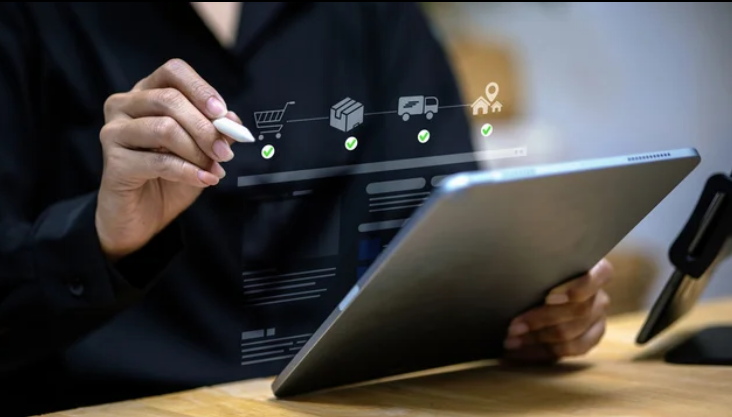
E-commerce is the buying and selling of products or services online. It makes shopping and business transactions easy through the internet.
Governmental regulation
In the United States, California’s Electronic Commerce Act (1984), enacted by the Legislature, the more recent California Privacy Rights Act (2020), enacted through a popular election proposition and to control specifically how electronic commerce may be conducted in California. In the US in its entirety, electronic commerce activities are regulated more broadly by the Federal Trade Commission (FTC). These activities include the use of commercial e-mails, online advertising and consumer privacy. The CAN-SPAM Act of 2003 establishes national standards for direct marketing over e-mail. The Federal Trade Commission Act regulates all forms of advertising, including online advertising, and states that advertising must be truthful and non-deceptive.[11] Using its authority under Section 5 of the FTC Act, which prohibits unfair or deceptive practices, the FTC has brought a number of cases to enforce the promises in corporate privacy statements, including promises about the security of consumers’ personal information.[12] As a result, any corporate privacy policy related to e-commerce activity may be subject to enforcement by the FTC.
The Ryan Haight Online Pharmacy Consumer Protection Act of 2008, which came into law in 2008, amends the Controlled Substances Act to address online pharmacies.[13]
Conflict of laws in cyberspace is a major hurdle for harmonization of legal framework for e-commerce around the world. In order to give a uniformity to e-commerce law around the world, many countries adopted the UNCITRAL Model Law on Electronic Commerce (1996).[14]
Internationally there is the International Consumer Protection and Enforcement Network (ICPEN), which was formed in 1991 from an informal network of government customer fair trade organisations. The purpose was stated as being to find ways of co-operating on tackling consumer problems connected with cross-border transactions in both goods and services, and to help ensure exchanges of information among the participants for mutual benefit and understanding. From this came Econsumer.gov, an ICPEN initiative since April 2001. It is a portal to report complaints about online and related transactions with foreign companies.
There is also Asia Pacific Economic Cooperation. APEC was established in 1989 with the vision of achieving stability, security and prosperity for the region through free and open trade and investment. APEC has an Electronic Commerce Steering Group as well as working on common privacy regulations throughout the APEC region.
In Australia, trade is covered under Australian Treasury Guidelines for electronic commerce and the Australian Competition & Consumer Commission[15] regulates and offers advice on how to deal with businesses online,[16] and offers specific advice on what happens if things go wrong

E-commerce has changed the way people shop and do business. With just a few clicks, customers can explore products, compare prices, place orders, and receive them at home. It offers convenience, flexibility, and opportunities for businesses to reach customers worldwide.
The European Union undertook an extensive enquiry into e-commerce in 2015–16 which observed significant growth in the development of e-commerce, along with some developments which raised concerns, such as increased use of selective distribution systems, which allow manufacturers to control routes to market, and “increased use of contractual restrictions to better control product distribution”. The European Commission felt that some emerging practices might be justified if they could improve the quality of product distribution, but “others may unduly prevent consumers from benefiting from greater product choice and lower prices in e-commerce and therefore warrant Commission action” in order to promote compliance with EU competition rules.[18]
In the United Kingdom, the Financial Services Authority (FSA)[19] was formerly the regulating authority for most aspects of the EU’s Payment Services Directive (PSD), until its replacement in 2013 by the Prudential Regulation Authority and the Financial Conduct Authority.[20] The UK implemented the PSD through the Payment Services Regulations 2009 (PSRs), which came into effect on 1 November 2009. The PSR affects firms providing payment services and their customers. These firms include banks, non-bank credit card issuers and non-bank merchant acquirers, e-money issuers, etc. The PSRs created a new class of regulated firms known as payment institutions (PIs), who are subject to prudential requirements. Article 87 of the PSD required the European Commission to report on the implementation and impact of the PSD by 1 November 2012.[21]